
Digital strategy for CEOs: scale, data and customers
A digital strategy that survives a board review: what scalability really constrains, moving from intuition to evidence, and forecasting before you commit.
Most documents called a digital strategy are a list of technologies with a budget attached. They are approved because nobody wants to argue against modernisation, and they fail because a list is not a strategy.
A strategy says what you will do, what you will not do, and how you will know it worked. This is how to write one that survives the second board meeting.
It is not a technology project
The distinction matters because it determines who owns it.
A technology project has a technical outcome — a platform live, a migration done. A digital strategy has a business outcome, and technology is how it is delivered. If the CEO cannot state the strategy without naming a product, it is a procurement plan.
A test that separates the two: if a supplier went out of business tomorrow, would the strategy change? If yes, the supplier was the strategy.
Scalability: the constraint that shows up late
Scalability is discussed as a capacity question and is almost never one. Capacity is easy to buy.
What actually limits growth is structural:
- A change that needs four systems to agree takes a quarter regardless of engineering effort
- A process that requires a person at step three cannot exceed the throughput of that person
- A system nobody wants to modify sets the pace of everything that depends on it
These are architectural and organisational constraints, and adding people or infrastructure does not move them. They also do not announce themselves — they appear as a growing sense that everything takes longer than it should, which it does.
The question worth asking annually: if volume tripled, what breaks first? The answer is almost never the servers.
From intuition to evidence
Most mid-market companies run on informed intuition, which is better than its reputation — experienced people are often right. The problem is that intuition does not scale past the people who have it, and it cannot be checked.
Moving to evidence does not require a data platform. It requires, per important decision:
- A named metric that would change if the decision were right
- A source for that metric that does not involve someone exporting to a spreadsheet
- A cadence at which it is actually looked at
That third point is where most attempts fail. Dashboards get built and not read, because no decision is scheduled against them.
Start with one decision, not with a platform. A full data programme ahead of any decision is how three-year initiatives with nothing to show begin — a pattern covered in six data foundation gaps that derail transformation.
Customer experience as the ordering principle
When a roadmap has thirty items and capacity for eight, something has to order them. Customer impact is the ordering principle that holds up best, because it is the one nobody can argue is illegitimate.
Practically, it means knowing two things you may not currently know:
- Where customers actually struggle — from support data and observation, not from an internal workshop
- What it costs you when they do — churn, support load, discount given to retain
Without the second number, customer experience work competes with revenue work on unequal terms, and loses.
Choosing partners without creating dependency
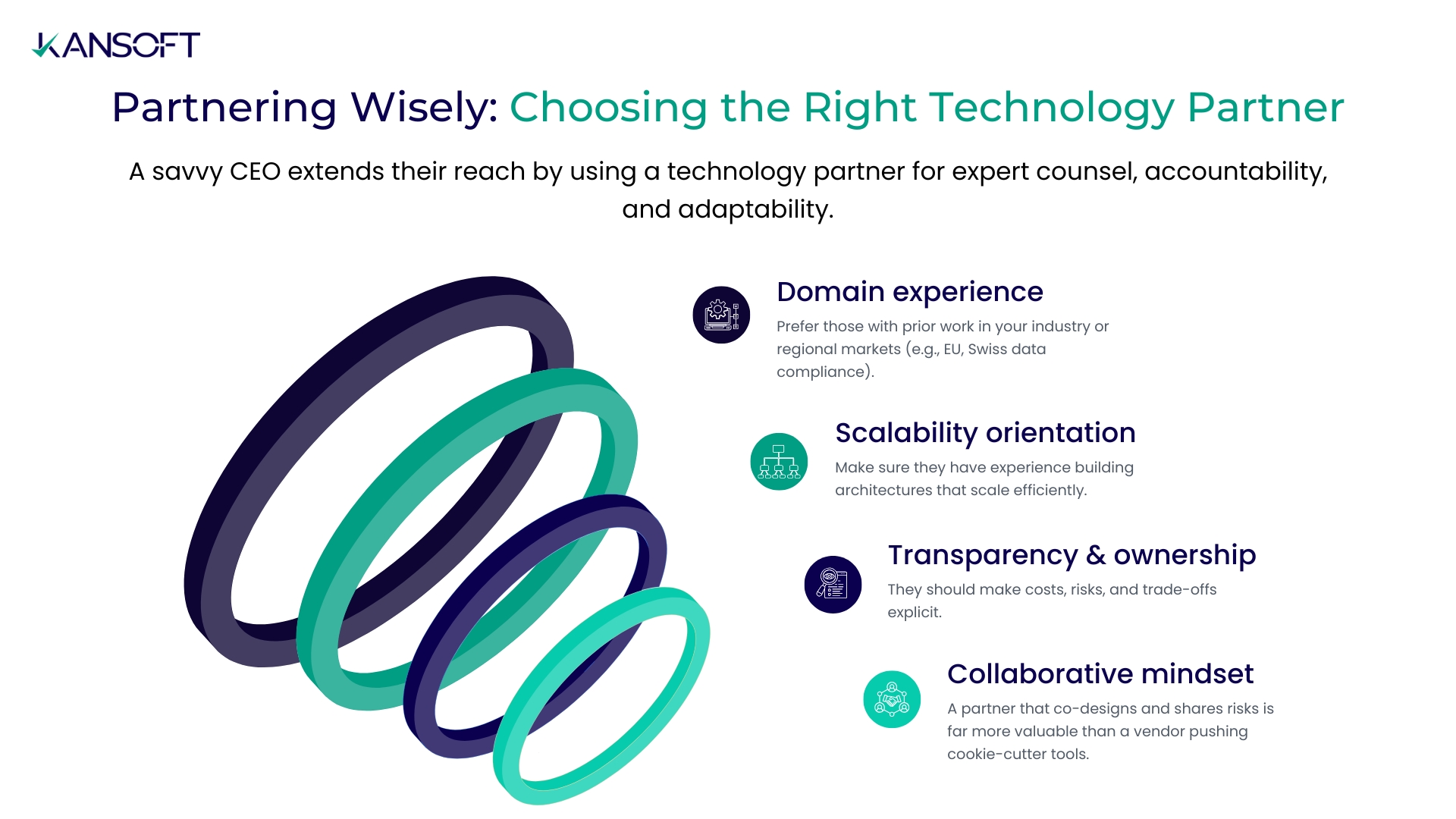
Most Swiss mid-market digital strategies involve outside capacity. The selection criteria that matter are not the ones in most RFPs.
- Does knowledge transfer, or accumulate on their side? A partner whose value depends on you not understanding the system is a structural risk.
- Is there a named team, or a pool? Continuity determines quality here more than any certification does.
- Who contracts, and under which jurisdiction? For revDSG and GDPR obligations, accountability sitting in the same jurisdiction as the obligation is worth a great deal.
- What does exit look like? If the answer is vague, you are buying a dependency rather than a capability.
Forecast before you commit
The most common planning failure is not a wrong estimate. It is committing to a three-year programme on a one-year forecast.
A more robust shape:
- Commit to the first increment fully — scope, budget, date
- Plan the second in outline, with a decision point at the end of the first
- Sketch the rest, and expect it to change
This looks less decisive and produces better outcomes, because each increment produces evidence that improves the next decision. It also matches how capital actually behaves in an uncertain market — a point developed in the growth-ready CEO.
The strategy on one page
If it cannot fit on one page, it will not be remembered, and a strategy nobody remembers does not order decisions.
What belongs on it:
- The business outcome, stated as a number with a date
- The two or three constraints currently preventing it
- What you will do about each, in sequence
- What you are explicitly not doing this year
- How you will know, and when you will check
Point 4 is the one most often omitted and the one that makes it a strategy. A plan that excludes nothing has not chosen anything.
Related reading
- Seven digital transformation shifts to address in 2026
- The engineering ROI playbook
- Digital transformation the Swiss way
If you want an outside read on which constraint is binding yours, book a call. No obligation.